
Target Weight Range in Eating Disorder Treatment: Defined
What is Relative Energy Deficiency in Sport (REDs)?
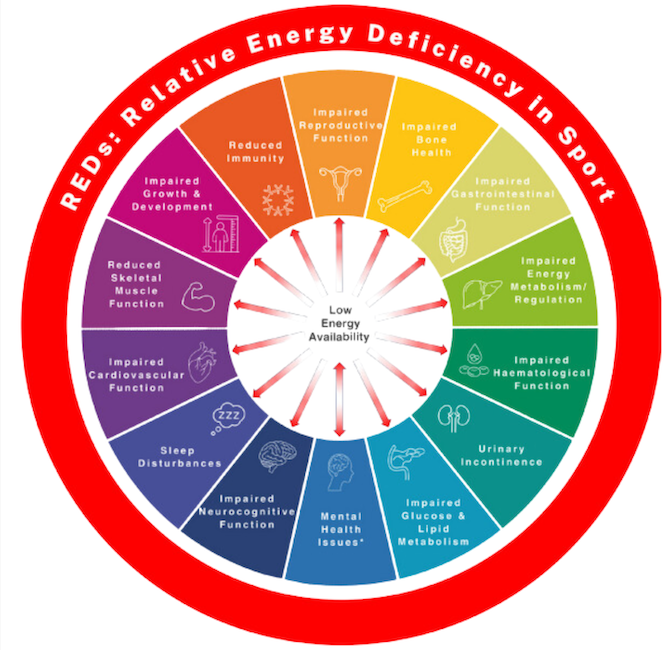
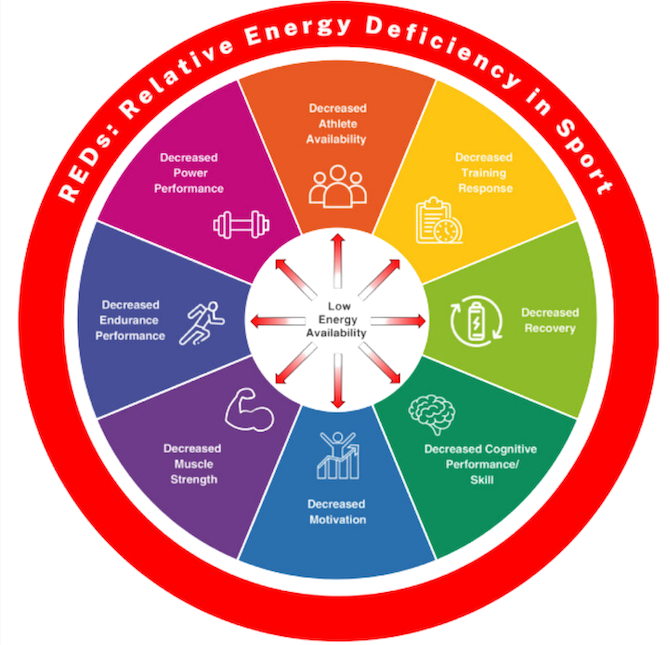
Relative Energy Deficiency in Sport, or REDs, is a medical condition that occurs when an athlete does not eat enough to support the amount of training they are doing. It impacts almost every system in the body and can occur in athletes of all genders, body sizes, and competitive levels. Without proper treatment, it can harm both health and performance. Below are graphics that shows how.
Why a Sports Dietitian Is Key to Treating REDs
A sports dietitian is uniquely qualified to assess an athlete's eating pattern and identify areas where they're falling short. They are able to compare an athlete's intake to their estimated needs for their level of training. When undereating, this state is called low energy availability, which describes the basis of how REDs happens. Here are some ways that a sports dietitian helps with this:
1. Assessing energy intake relative to sport demands (aka determining the extent of low energy availability)
A sports dietitian will review what an athlete typically eats in a day, estimating total caloric and nutrient intake. Estimation equations are used to determine total calorie needs, relative to the demands of sport. These two values can be compared to further understand what percentage of their calorie needs an athletes is actually meeting. Our sports dietitians often find their athletes to be consuming less than 75% of their actual energy needs, if not even less, even if a REDs diagnosis has not yet been given.
2. Providing education on how much is needed to support amount of training
A sports dietitian develops a personalized fueling plan that helps the athlete eat adequately and frequently to match their training load. Our sports dietitians are often recommending 3 meals and 2-3 snacks, completing an eating session every 3-4 hours. Each fueling plan is always individualized to fit the athlete's schedule, preferences, and sport.
3. Assessing growth or weight history (if available) and determining need for weight restoration
When an athlete is under-fueling for their activity level, this may lead to weight loss or lack of expected growth in height and weight. Sports dietitians are able to review historical growth trends, using growth charts, to determine if an athlete has become weight suppressed or height stunted. In addition to increasing energy intake, an athlete may need to also gain weight to fully resolve symptoms as well. Our dietitians will review growth charts for all clients that are until the age of 23. For adult clients, they will do their best to collect a complete metric history.
Although KCPN adopts a Health At Every Size approach, weight suppression and stunted growth can lead to severe medical issues (low heart rate, low blood pressure, eating disorders, low blood sugar, etc) that is a crucial area to address by a sports dietitian. Our dietitians do not prescribe weight loss or endorse weight manipulation but will absolutely assess weight history and address weight restoration.
4. Assessing risk and providing nutrition support for disordered eating
Generally speaking, most sports dietitians are equipped to identify if there's a disordered eating component playing a role in an athlete's ability to fueling appropriately for their sport. Not all sports dietitians are equipped to provide nutrition intervention, unless they've received speciality training. If this is the case, sports dietitians can provide referrals to dietitians, medical providers, and mental health providers (like a therapist or psychologist).
Our owner and founder, Sara Arnold, is a Certified Eating Disorders Specialist (CEDS) and provides nutrition intervention for athletes experiencing the following eating disorders: Anorexia Nervosa, Bulimia Nervosa, Orthorexia Nervosa, Binge Eating Disorder, and Avoidant/Restrictive Food Intake Disorder (ARFID). All sports dietitians at KCPN are equipped to support disordered eating.
Eating disorder specialists help athletes:
- Increase total energy intake safely and sustainably
- Reduce risk of and address nutrient deficiencies often seen with eating disorders (calcium, vitamin D, iron, vitamin B12)
- Challenge diet culture and body size beliefs that are common in sport
- Rebuild trust with food and their bodies
Treatment for an eating disorder requires an interdisciplinary team, often including a physician and mental health provider. KCPN dietitians value care coordination and will provide any necessary referrals to these providers as well as collaborate as needed during treatment.
5. Identifying if level of activity is safe and appropriate for current intake
When an athlete is under-fueling, it may be inappropriate - or even dangerous - to continue participating in physical activity.
Over time, malnutrition can weaken the cardiac muscle, leading to a dangerously low heart rate (below 50 bpm) that is not due to athletic conditioning but to under-fueling. Sustained low energy availability can also negatively impact blood glucose regulation and bone density.
At KCPN, our dietitians use an evidence-informed approach from Safe Exercise At Every Stage (SEES)
to help determine whether activity levels are safe and appropriate during recovery.
6. Identifying sustainable fueling habits to prevent REDs long term
REDs recovery does not end once symptoms improve. A sports dietitian educates athletes on:
- Building sustainable fueling habits
- Adjusting nutrition during heavy training or competition periods
- Recognizing early warning signs of low energy availability
This proactive approach helps prevent recurrence and supports longevity in sport.
REDs is Serious - but Treatable
With proper nutrition support, athletes can restore their health and improve performance.
At KCPN, our sports dietitians specialize in helping athletes recover from REDs through individualized nutrition strategies. Fueling is not optional - it's foundational to both health and success in sport.
If you suspect REDs or want to ensure your nutrition supports your training, working with a sports dietitian is a non-negotiable first step.
Frequently Asked Questions
1. What are the early signs of REDs?
Early signs may include fatigue, frequent injuries (especially stress fractures), decreased performance, mood changes, irregular or absent menstrual cycles in female athletes or low libido/loss of morning erections in male athletes, iron deficiency, and poor recovery from training sessions. Because symptoms can be subtle at first, early assessment is important.
2. Can male athletes develop REDs?
Yes. REDs does not discriminate and can affect any athlete. While loss of period is a common sign in females, males may experience low testosterone levels, low libido, or loss of morning erection.
3. How long does it take to recovery from REDs?
Recovery time varies depending on severity and duration of low energy availability. Some improvements (like energy levels) may occur within a few days of adequate fueling, while hormonal recovery and bone density improvements can take several months or years.
4. Can you recover from REDs without gaining weight?
Yes. Not everyone that underfuels their body loses weight or stops growing in height. In fact, some athletes may actually experience weight gain, even though they're training more and eating less. This phenomenon can be partially explained by the body's attempt to slow metabolism in response to starvation. A sports dietitian can assess individual needs and guide appropriate care.